Mobile Coffee Trailer: How to Spec One for the Way You Will Actually Trade
Weekday pitch, events, corporate or weddings — each needs a different build. Water, power, ice, bar layout and the three coffee platforms compared.
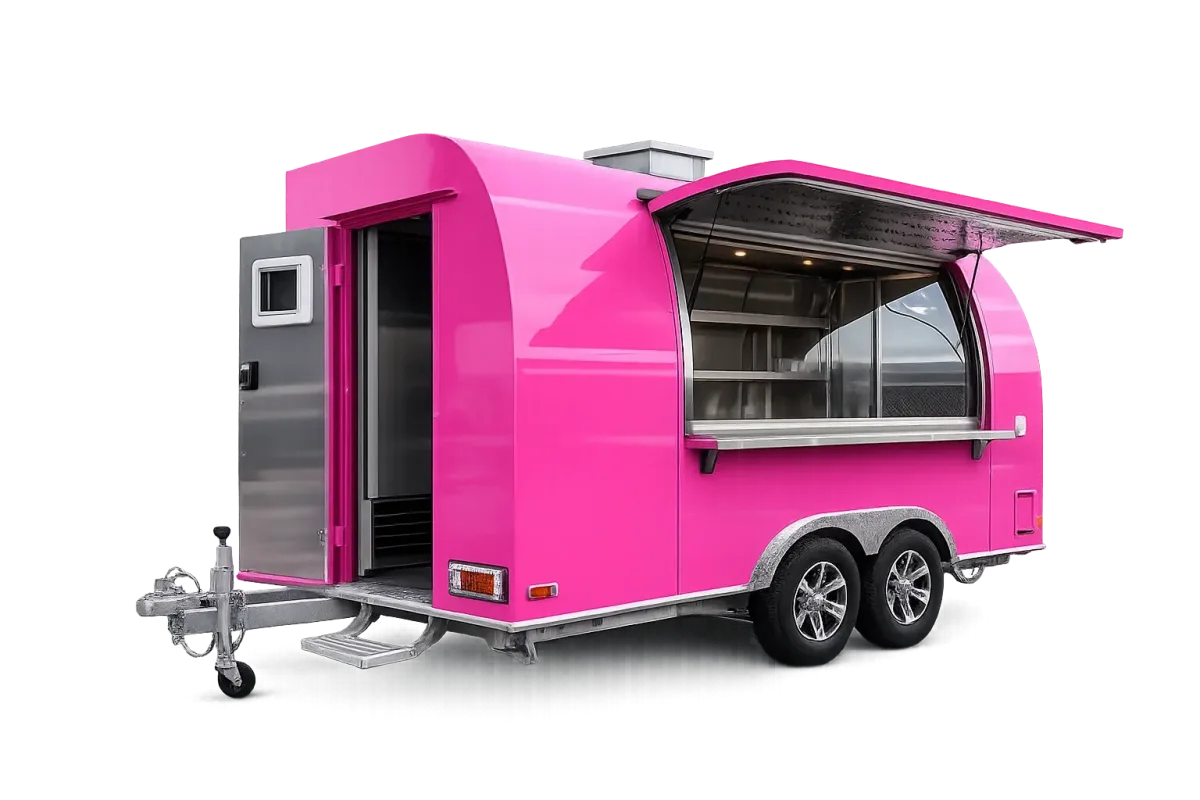
Coffee is the easiest mobile food business to start and one of the easier ones to specify badly.
The reason is that the machine gets all the attention. Operators spend weeks choosing between grinders and then discover that the constraint on a busy morning was the ice bin, the water tank, or the fact that two people cannot pass each other behind the bar.
A mobile coffee trailer is specified by how and where it trades. A unit doing a weekday office pitch has almost nothing in common with one doing weekend weddings, even if both sell the same flat white.
This guide covers the four trading patterns, what each one demands from the build, how power and water work when there is no hookup, and which of the Carolina coffee platforms fits which pattern. If you are still deciding whether a trailer is right at all, start with our guide to choosing a coffee trailer and come back to this one for the build.
Four ways a mobile coffee trailer makes money
The weekday pitch
A fixed spot near offices, a transit stop, a gym or a school run. Steady, early, and almost entirely about throughput between seven and nine in the morning. The menu stays short and the queue is the whole business.
Events and markets
Weekends, higher volume in bursts, and a different site every time. Setup speed and self-sufficiency matter more than anything else, because you cannot rely on the site for power or water.
Corporate and office catering
Booked in advance, paid per head or per hour, and often indoors-adjacent. The trailer's appearance is part of what is being bought.
Weddings and private events
The highest margin of the four and the most appearance-driven. Here the shell of the trailer is not cosmetic, it is the product.
Most operators run two of these. The specification follows from whichever pays the rent.
What each pattern demands from the build
| Trading pattern | What it needs most | What matters less |
|---|---|---|
| Weekday pitch | Throughput, short menu, fast setup | Appearance, menu range |
| Events and markets | Water and power autonomy, storage | Being compact |
| Corporate catering | Appearance, reliability, a clean finish | Peak throughput |
| Weddings | The look of the trailer, quiet running | Menu range, volume |
Two things fall out of that table.
If you are doing volume, buy for the bar layout and the ice. If you are doing weddings, buy for the shell. Carolina builds the 10 ft Airstream / Midnight in a polished airstream or blacked-out midnight finish for exactly this reason: on a wedding booking, the trailer is photographed more than the coffee is.
Setup and pack-down time is a real cost
Nobody costs this in, and over a year it is one of the largest numbers in a mobile coffee business.
A trailer that takes forty minutes to set up and thirty to pack down is losing more than an hour of every trading day, and on a weekday pitch that is most of the profitable window. The variables are how much has to be stowed for towing, how the power and water connect, and whether the serving hatch, signage and awning are one-person jobs.
Two practical rules. Anything you have to lift every day should be light enough to lift on a cold morning at six. And anything that has to be connected should be reachable without moving something else first.
This is also the strongest argument for a build where the plumbing and wiring were installed by the people who designed the layout, rather than fitted afterwards by whoever was available.
Water, power and ice
These three decide whether you can trade at a site or not, and all three are built in rather than added.
Water
Espresso needs a supply and a waste route, and no event site is obliged to give you either. A fresh tank, a waste tank with more capacity than the fresh, a pump and a water heater are the baseline. Every Carolina platform ships plumbed and tanked as standard.
Power
An espresso machine is one of the heavier draws in mobile catering, and it runs alongside refrigeration and a grinder. This is not a domestic circuit. Carolina wires every platform for 220 V service with the panel sized to the platform.
Ice
The most underestimated item in any mobile coffee trailer built after about 2015. Iced drinks are now a large share of most menus and they consume ice far faster than operators plan for. Our coffee platforms carry a double-door ice bin as standard rather than as an option, which is a direct response to how menus have shifted.
Mistakes that cost coffee operators money
- Buying the machine before the trailer. The machine is the easiest thing to change later. The bar layout is not.
- Underestimating ice. Iced drinks are a large share of most menus now, and running out at eleven on a hot Saturday ends the day early.
- Building a long menu. Every additional syrup and alternative milk is a slot on a bar that has finite reach, and on a queue-driven pitch it slows the whole line.
- Ignoring waste water capacity. Waste fills faster than fresh empties, and a full waste tank stops service exactly as firmly as an empty fresh one.
- Choosing the body on price alone. The 8 ft is not a compromise if you are one operator on a fixed pitch. It is the correct platform, and the 10 ft is the correct one if you need the shell. Neither is a downgrade of the other.
Layout is throughput
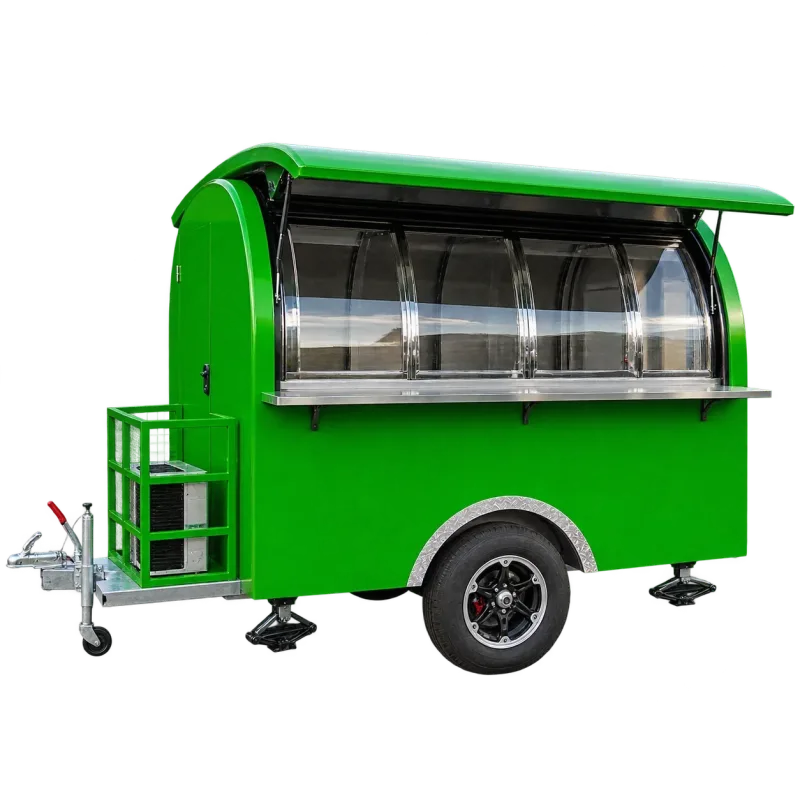
On a busy morning, the difference between eighty drinks an hour and one hundred and forty is rarely the machine. It is how many steps the barista takes per drink.
Three things to look at in any layout before you buy:
- The service window position relative to the bar. The barista should turn, not walk, to hand over.
- Whether two people can work without colliding. If you intend to run two on peak mornings, the body has to allow it. Some compact builds are genuinely single-operator, and that is fine as long as you know it before the first market.
- Where the ice, milk and cups sit. These are touched on every single drink. If any of them is behind you or below knee height, you will feel it by the two hundredth cup.
Carolina offers the 8 ft Coffee Trailer with a half-round or fully-round espresso bar, which is a layout decision rather than a cosmetic one: the round bar puts more of the working surface within reach of one operator.
The coffee platforms Carolina builds
Carolina Food & Coffee Trailers builds mobile kitchens in Charlotte, North Carolina, fabricated, plumbed and wired in the same shop. Three of the eight platforms are coffee-led.
| Platform | Size | Axle | Built around | Sinks |
|---|---|---|---|---|
| 8 ft Coffee Trailer | 8 ft | Single | Half-round or fully-round espresso bar, fridge, double-door ice bin | 1+1 |
| 10 ft Airstream / Midnight | 10 ft | Double | Polished airstream or blacked-out shell, full coffee service | 1+1 |
| 14 ft Coffee & Kitchen | 14 ft | Single | Two double-basket fryers, four-burner stove with oven, freezer, full prep | 3+1 |
How to choose between them
- 8 ft if coffee is the whole business and you want the easiest platform to tow, park and pitch. It is the compact opener, and for a single operator doing a weekday pitch it is often the right answer rather than the cheap one.
- 10 ft Airstream or Midnight if appearance is part of what you are selling. Weddings, brand activations and corporate bookings are where the airstream shell earns its keep.
- 14 ft Coffee & Kitchen if you are adding hot food. That platform crosses into full kitchen territory, which is why it carries 3+1 sinks rather than 1+1.
The dessert bodies, the 10 ft Cake Trailer and the 8 ft Donut & Pretzel, are worth a look if you are pairing drinks with a food product. The full range with every price published is on the fleet page.
Sinks and the health code
Drinks-led operations are usually held to a lighter standard than open food handling, which is why the coffee and dessert platforms ship with a 1+1 sink while the full kitchen platforms ship with a 3+1.
Usually is not always. Add a food item to a coffee menu and the requirement can change, and requirements vary by county and state in any case.
Tell us on WhatsApp the county you will be permitted in and what you intend to serve, including anything you might add later, and we will confirm the configuration before you pick a platform. That conversation costs nothing and it is considerably cheaper than discovering the answer at an inspection.
What Carolina includes
- Eight production platforms, 8 ft to 14 ft, covering coffee, food, pizza and dessert.
- Plumbing, tanks and 220 V wiring as standard, in-house rather than subcontracted.
- Seventeen priced options, with upgrade rules written down.
- Every price published up front on each spec page.
- A 3D build studio for configuring the body and the bar before committing.
- Health-code guidance against your county's requirements.
- A warranty, with support from the people who built the unit.
- Answers on WhatsApp, usually the same day.
Buying one
- Check the price yourself. Every coffee platform's price, and every option price, is published on the fleet page. No form and no callback required.
- Configure the build in the 3D build studio, including the bar shape and the body style.
- Ask for a firm quote. Send the details or message us on WhatsApp with how you plan to trade, your busiest expected hour and your county. You will get the exact price for that configuration and a build slot.
Tell us the trading pattern rather than the machine you want, and the recommendation will be better. If the honest answer is the 8 ft rather than the 10 ft, that is what you will hear.
Frequently asked questions
What size mobile coffee trailer do I need?
An 8 ft body handles a full espresso menu for one operator, which covers most weekday pitches. Move to 10 ft for a more presentable shell and more working room, and to 14 ft only if you are adding hot food.
Do I need plumbing in a coffee trailer?
Yes. Espresso needs a water supply, a waste route and hot water, and event sites will not provide them. Fresh and waste tanks, a pump and a water heater are the baseline, and they are standard on every Carolina platform.
How much power does a mobile coffee trailer need?
More than a domestic circuit. The espresso machine, grinder and refrigeration run together through service, which is why every Carolina platform is wired for 220 V with the panel sized to the build.
How many sinks does a coffee trailer need?
Drinks-led operations commonly need a handwash sink plus a smaller warewashing set-up, which is the 1+1 configuration on our coffee platforms. Adding food to the menu can change that, and rules vary by county, so confirm before choosing.
Is an airstream-style trailer worth it?
If you trade at weddings, brand events or corporate bookings, the shell is part of what you are being paid for and it usually pays back. For a weekday office pitch, it is a preference rather than a business case.
How many drinks an hour can one person make?
It depends far more on layout than on equipment. Keep ice, milk and cups within reach and the service window behind the barista's shoulder rather than across the trailer, and the same person and the same machine will produce noticeably more.
Can Carolina build a coffee trailer to my layout?
The bar configuration and body style are chosen per build in the 3D build studio, from seventeen priced options with the upgrade rules written down.
Conclusion
The best mobile coffee trailer is not the one with the most impressive machine. It is the one specified for where it will park.
Work out which of the four trading patterns pays your rent, then buy for that: throughput and ice for volume, autonomy for events, and the shell for weddings. Get the water, the power and the layout right and the coffee side is the easy part.
Carolina builds three coffee-led platforms in Charlotte, each plumbed, tanked and wired for 220 V as standard, with every price published on the page rather than quoted on request. Browse the fleet, configure a build, or ask for a quote and tell us how you plan to trade.
Still deciding?
Send us the menu and where you plan to park. We will come back with a platform, a spec and the size rules that apply to it.